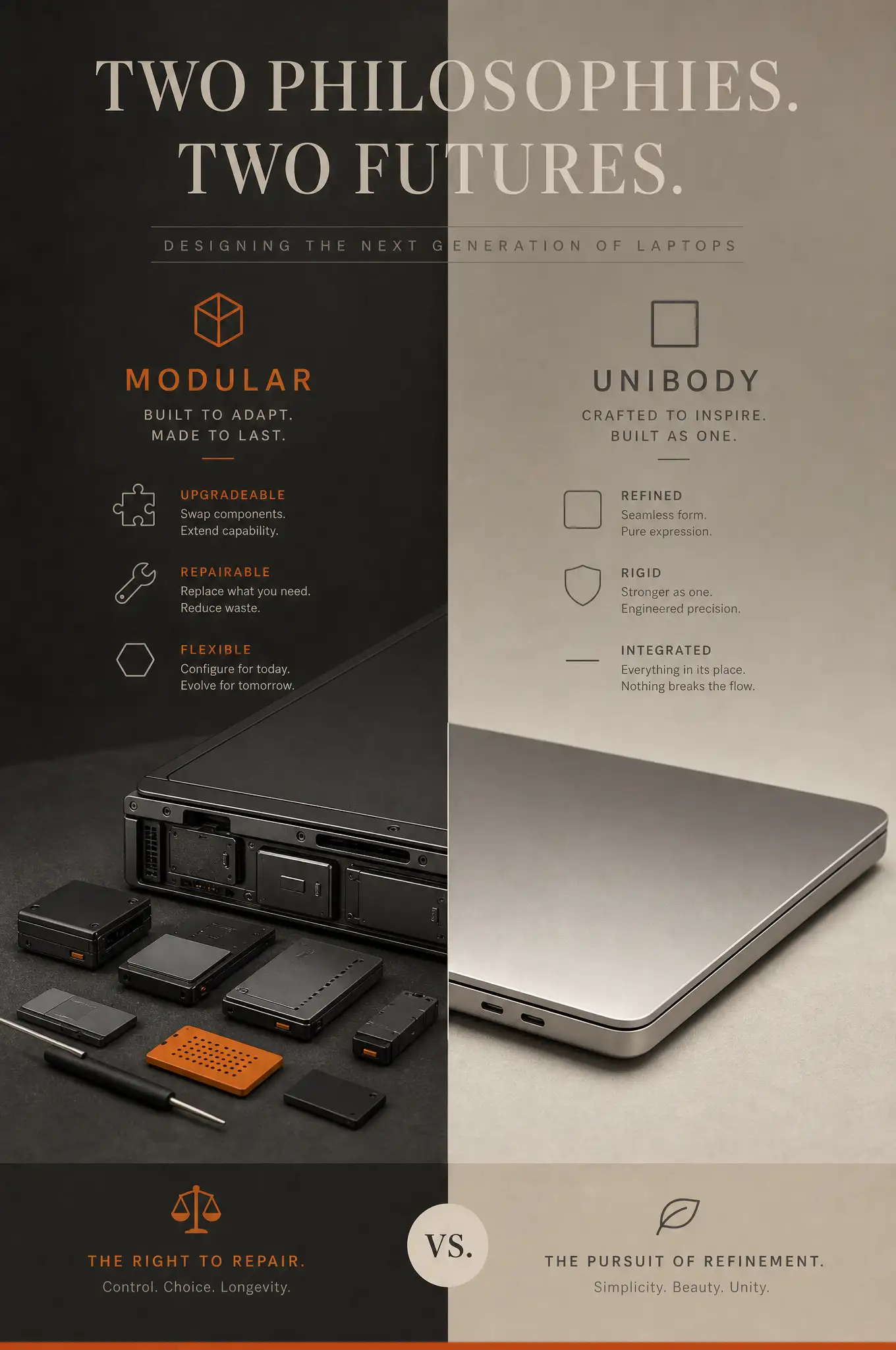
Two 16-inch laptops, two very different philosophies. The Framework Laptop 16 is built to be opened, upgraded, and repaired by its owner. The MacBook Pro 16 is built to be sealed, optimized, and replaced when it gets old.
Both are premium machines aimed at professionals. Both cost north of $2,000. But the experience of owning one versus the other could not be more different. Here is how they stack up.
Build and Repairability
The Framework Laptop 16 is the most repairable laptop ever made. Every component — RAM, storage, battery, keyboard, trackpad, display, even the GPU — can be swapped with a single screwdriver. Framework sells upgrade kits, and the company publishes repair guides for free. The expansion card system lets you customize ports: need two USB-C and an HDMI today? Swap to three USB-A and Ethernet tomorrow.
The MacBook Pro 16 is the opposite. RAM and storage are soldered to the motherboard. The battery is glued in. Replacing the display costs nearly as much as a new laptop. Apple’s build quality is superb — the aluminum unibody feels indestructible — but when something breaks, you are taking it to the Apple Store, not fixing it yourself.
If you keep laptops for five years or more, Framework’s modularity means you can upgrade components incrementally instead of buying a whole new machine. If you trade in every two or three years anyway, Apple’s approach hurts less.
Performance
The MacBook Pro 16 with M5 Pro is a beast. Single-core performance leads the industry. Multi-core performance handles 8K video editing and large code compiles without breaking a sweat. The unified memory architecture means the GPU has access to up to 36GB of shared memory, which is game-changing for machine learning and video work.
Framework Laptop 16 uses AMD Ryzen 7040-series processors with optional Radeon RX 7700S discrete graphics. Raw CPU performance is competitive with the M5 Pro on multi-threaded workloads but trails significantly on single-core. The discrete GPU option gives Framework an edge in gaming and 3D rendering, where dedicated VRAM matters.
For most professional workloads — coding, design, data analysis — either machine is more than fast enough. For sustained heavy rendering or local LLM inference, the MacBook’s unified memory gives it an advantage.
Display and Audio
Apple’s 16-inch Liquid Retina XDR display (3456 x 2234, 120Hz ProMotion) is the best screen on any laptop. 1,600 nits peak brightness for HDR content, perfect color accuracy out of the box, and the mini-LED backlight makes blacks look nearly OLED-deep.
Framework’s 16-inch display (2560 x 1600, 165Hz) is solid but not extraordinary. Colors are accurate at 100% DCI-P3, and the matte finish option is great for bright offices. The 165Hz refresh rate makes scrolling and gaming noticeably smoother than the MacBook’s 120Hz. But side by side, Apple’s display is visibly better — brighter, sharper, and more vibrant.
The MacBook’s six-speaker system remains the best laptop audio on the market. Framework’s speakers are fine for video calls but thin for music.
Operating System and Software
This is the biggest fork in the road. The MacBook Pro runs macOS — polished, stable, and deeply integrated with Apple’s ecosystem. If you use an iPhone, AirDrop, Handoff, and iMessage on your laptop are genuinely useful.
The Framework Laptop 16 runs Windows or Linux. Windows gives you access to every piece of enterprise software ever written. Linux gives you complete control and a development environment that many engineers prefer. Framework officially supports Ubuntu and Fedora, and the community maintains excellent support for Arch and other distros.
If you live in Final Cut Pro or Xcode, get the MacBook. If you need Windows-only software or prefer Linux, Framework is the obvious choice.
Verdict
The MacBook Pro 16 is the better laptop in a vacuum — better screen, better speakers, better single-core performance, and longer battery life. But the Framework Laptop 16 offers something Apple cannot: the ability to fix, upgrade, and customize your machine years after purchase. If that matters to you, no amount of Apple polish can compete.