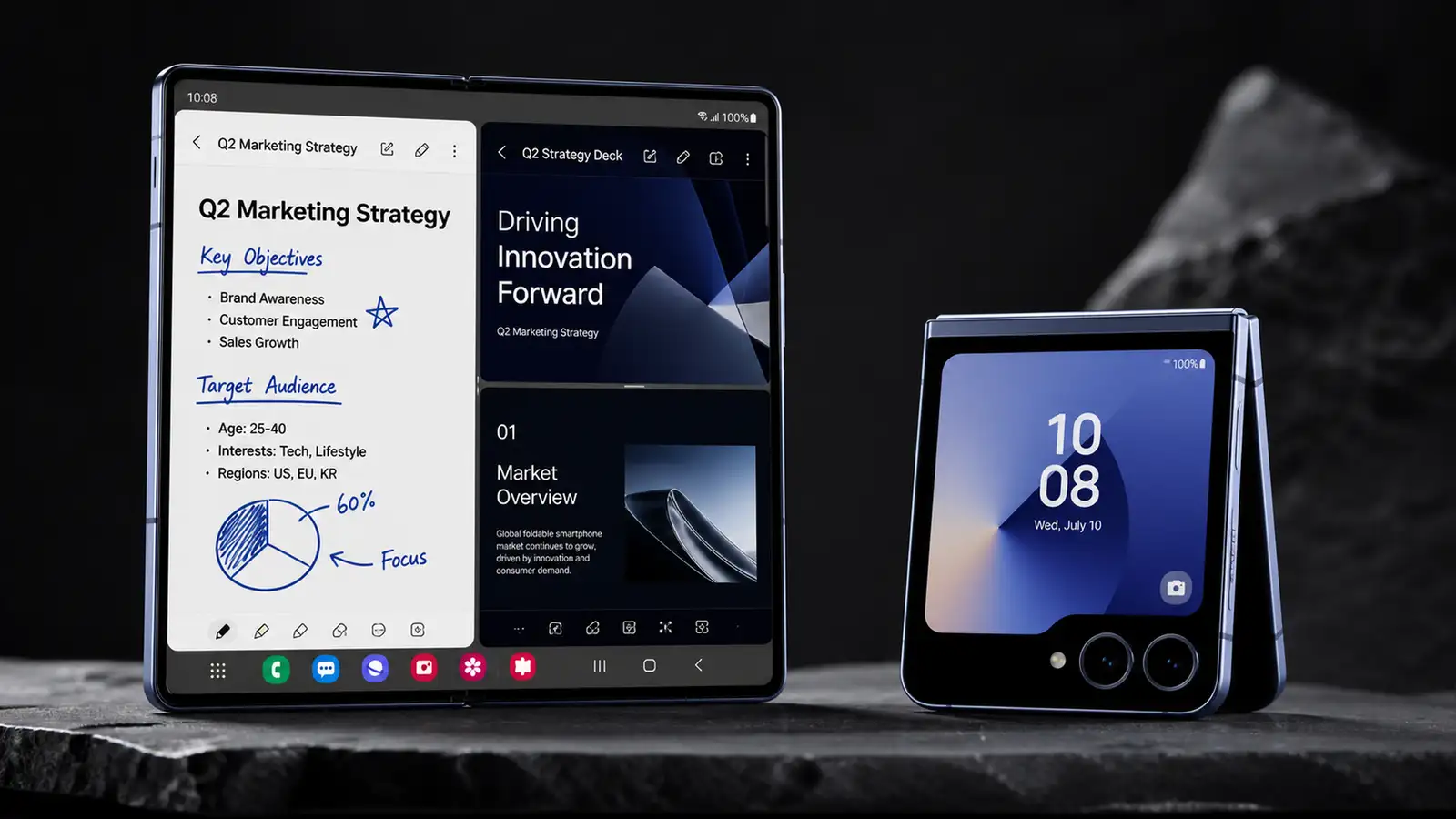
Samsung’s summer Unpacked event hasn’t happened yet, but the 2026 foldable lineup has already leaked in extraordinary detail. Evan Blass — the leaker who has been accurately predicting Samsung launches for over a decade — dropped press renders and full spec sheets for the Galaxy Z Fold 8 and Galaxy Z Flip 8 through his Substack in mid-July (SamMobile, July 2026). Pricing from WinFuture followed shortly after (9to5Google, July 2026). The details are credible enough to make an early call on which foldable is actually worth the money.
The short version: the Z Fold 8 is a ground-up redesign with a wider cover screen and better cameras. The Z Flip 8 is an iterative update with a price hike. If you’re trying to decide between them, the question isn’t which one is better on a spec sheet. It’s which form factor fits how you actually use your phone.
Design: A tale of two foldables
The Galaxy Z Fold 8 is a complete departure from the long, narrow cover screen that defined every previous Fold. The new device is shorter and wider — a form factor that, on paper, should make the cover display usable as an actual phone rather than a cramped afterthought. This addresses the single biggest complaint about every Fold since the original: the outer screen always felt like a compromise you tolerated to get to the inner tablet.
The Z Flip 8, by contrast, looks nearly identical to the Z Flip 7. Same clamshell design. Same form factor. Same basic silhouette. Samsung is betting that people who bought a Flip didn’t want it to change — they wanted it to get better at being a Flip. That’s a defensible call, but it also means the Fold 8 gets all the novelty this generation.
Both phones carry an IP48 rating for dust and water resistance, which is solid for foldables. The IP48 means full dust protection (the “4” was previously unheard of in foldables) and water resistance up to 1.5 meters for 30 minutes. Both have side-mounted fingerprint readers, stereo speakers, and USB-C ports. The premium feel should be comparable across both devices. The difference is in what you’re holding: one is a phone that becomes a tablet, the other is a phone that becomes half a phone you can fit in a small pocket.
Displays
The Z Fold 8’s wider cover screen is the headliner. Previous Fold models forced you to type on a screen that felt like a TV remote. Early renders suggest the Fold 8’s outer display will be much closer to a standard smartphone in width, which means typing, reading, and scrolling without constantly unfolding the device.
The inner display remains a roughly 7.6-inch flexible AMOLED — Samsung hasn’t radically changed the panel tech this generation, but the wider aspect ratio should make split-screen multitasking more natural. The “Now Nudge” feature in One UI 9.0, visible in the leaked renders, appears to make split-screen app switching faster with a gesture-based system. The Fold’s inner display also supports S Pen input, a feature entirely absent from the Flip lineup.
The Z Flip 8 keeps its 6.7-inch inner display and a cover screen that’s functional for widgets, notifications, and quick camera framing but not much else. The cover display cameras appear in the renders, confirming that Samsung is sticking with the folder-style cutout rather than moving to a full edge-to-edge cover screen.
If you spend a lot of time reading, working on documents, or watching video on your phone, the Fold’s larger canvas is a meaningful advantage. If your phone mostly lives in your pocket between quick checks, the Flip’s more compact folded state is the point.
Cameras
The camera gap between these two phones is wider than in any previous generation.
The Galaxy Z Fold 8 packs a 50MP primary sensor and a 50MP ultrawide — the first time Samsung has put the same resolution on both rear lenses in a foldable. There are also two 10MP front-facing cameras: one on the cover screen and one under the inner display. This dual-front-camera setup means you get the same selfie quality whether the phone is folded or open.
The Galaxy Z Flip 8 has a 50MP primary, a 12MP ultrawide, and a single 10MP front-facing camera. The main sensor matches the Fold 8, but the ultrawide takes a significant step down in resolution. For a phone that’s pitched as a content-creation tool — Samsung’s Flip marketing has always emphasized hands-free selfies and vlogging — losing ultrawide resolution compared to the Fold is a real tradeoff.
Neither phone is likely to match the Galaxy S26 Ultra’s camera system, which remains Samsung’s photography flagship. But between these two foldables, the Fold 8 has the clear edge for anyone who cares about versatility in their camera setup. The 50MP ultrawide on the Fold should capture significantly more detail in landscapes and group shots than the Flip’s 12MP option. If photography is a deciding factor for you, the Fold 8 is the answer — and it’s not particularly close.
Performance and battery
Samsung is splitting the processor strategy by model. The Z Fold 8 uses Qualcomm’s Snapdragon 8 Elite Gen 5 for Galaxy globally. The Z Flip 8 uses the same Snapdragon chip in the US and China, but switches to Samsung’s own Exynos 2600 in most other markets.
This split has been a source of frustration in previous Samsung generations. Exynos variants have historically run hotter and delivered shorter battery life than their Snapdragon counterparts. The Exynos 2600 is supposed to close that gap, but we won’t know until independent testing lands. If you’re outside the US or China and considering a Flip 8, it’s worth waiting for battery benchmarks before committing — the Exynos gap has burned buyers before.
On raw battery capacity, the Fold 8 pulls ahead with a 4,800mAh cell and 45W wired charging plus 20W wireless charging. The Flip 8 comes with a 4,300mAh battery — smaller, which makes sense given the smaller chassis — but Samsung hasn’t confirmed its charging speeds. If history holds, the Flip will charge slower.
For heavy users, the Fold’s larger battery and faster charging are straightforward advantages. For the Flip’s target audience — people who prioritize portability — the smaller battery is part of the tradeoff you’re signing up for.
Software: One UI 9.0 on both
Both devices run One UI 9.0, Samsung’s latest Android skin. The leaked renders show several features that appear exclusive to or optimized for the Fold 8’s larger canvas, including the “Now Nudge” split-screen multitasking gesture and a redesigned camera app with a “My FanCam” mode.
The Flip 8 gets the same software base but fewer tablet-specific features. Samsung has historically been good about bringing its foldable-specific software improvements to both form factors, but the Fold’s larger screen inevitably gets more attention from the software team. If you want the full One UI 9.0 foldable experience, the Fold delivers more of it. That said, the Flip’s Flex Mode — where the phone sits half-open on a surface — remains genuinely useful for video calls and self-timer photos, and that feature carries forward to the Flip 8 unchanged.
Price: The Fold gets cheaper, the Flip gets pricier
This is where the comparison gets interesting — and where Samsung’s strategy becomes harder to parse.
According to WinFuture’s leaked European pricing, the Galaxy Z Fold 8 starts at €1,999 for the 256GB model. The Galaxy Z Flip 8 starts at €1,299 for the 256GB model. US pricing typically lands lower than direct euro-to-dollar conversion, but the relative gap should hold: roughly $1,700-1,800 for the Flip, $2,300-2,400 for the Fold.
The Fold 8 is actually €100 cheaper than Samsung’s Galaxy Z Fold 8 Ultra, which is the same device with more RAM and storage at a higher price. The Fold 8 proper — the “wide” model — is the one Samsung expects most people to buy, and it’s priced accordingly.
The Flip 8, meanwhile, got a €100 price increase over the Flip 7’s launch price. That’s harder to justify when the hardware changes are modest. You’re paying more for what is essentially the same phone with a processor bump and One UI 9.0.
There’s also a Galaxy Z Fold 8 Ultra at €2,199 for 256GB — but that device is essentially the Fold 8 with more RAM and storage, and the value proposition is weak compared to the standard Fold 8.
Which one should you buy?
If you’re choosing between these two specific devices, the answer depends on what you want a foldable to do for you.
Buy the Galaxy Z Fold 8 if you regularly read, write, or work on your phone. The redesigned wider cover screen fixes the biggest ergonomic complaint about previous Folds, and the inner tablet remains unmatched for multitasking and media consumption. You’ll also get better cameras, a bigger battery, faster charging, and the Snapdragon processor globally. At the expected price, it’s the more complete device — and for the first time in the Fold series, the outer screen might actually be good enough that you unfold the phone because you want to, not because you have to.
Buy the Galaxy Z Flip 8 if portability is your top priority and you don’t mind paying more for a phone that hasn’t changed much. The Flip folds into something that fits in tiny pockets and small bags in a way the Fold never will. It’s the better choice if your phone is mostly for quick tasks — messaging, social media, snapping photos — and you value the ability to completely close it and forget about it. But the combination of an iterative design, a split processor strategy, and a price increase makes the Flip 8 harder to recommend at launch than the Fold 8.
If neither phone sounds quite right, there’s a third option that didn’t exist last year: wait and see what the Galaxy Z Fold 8 Ultra actually delivers, or look at the non-foldable Galaxy S26 Ultra, which will almost certainly outperform both foldables on cameras and battery for less money. Foldables have come a long way, but the traditional slab flagship still wins on value in 2026.