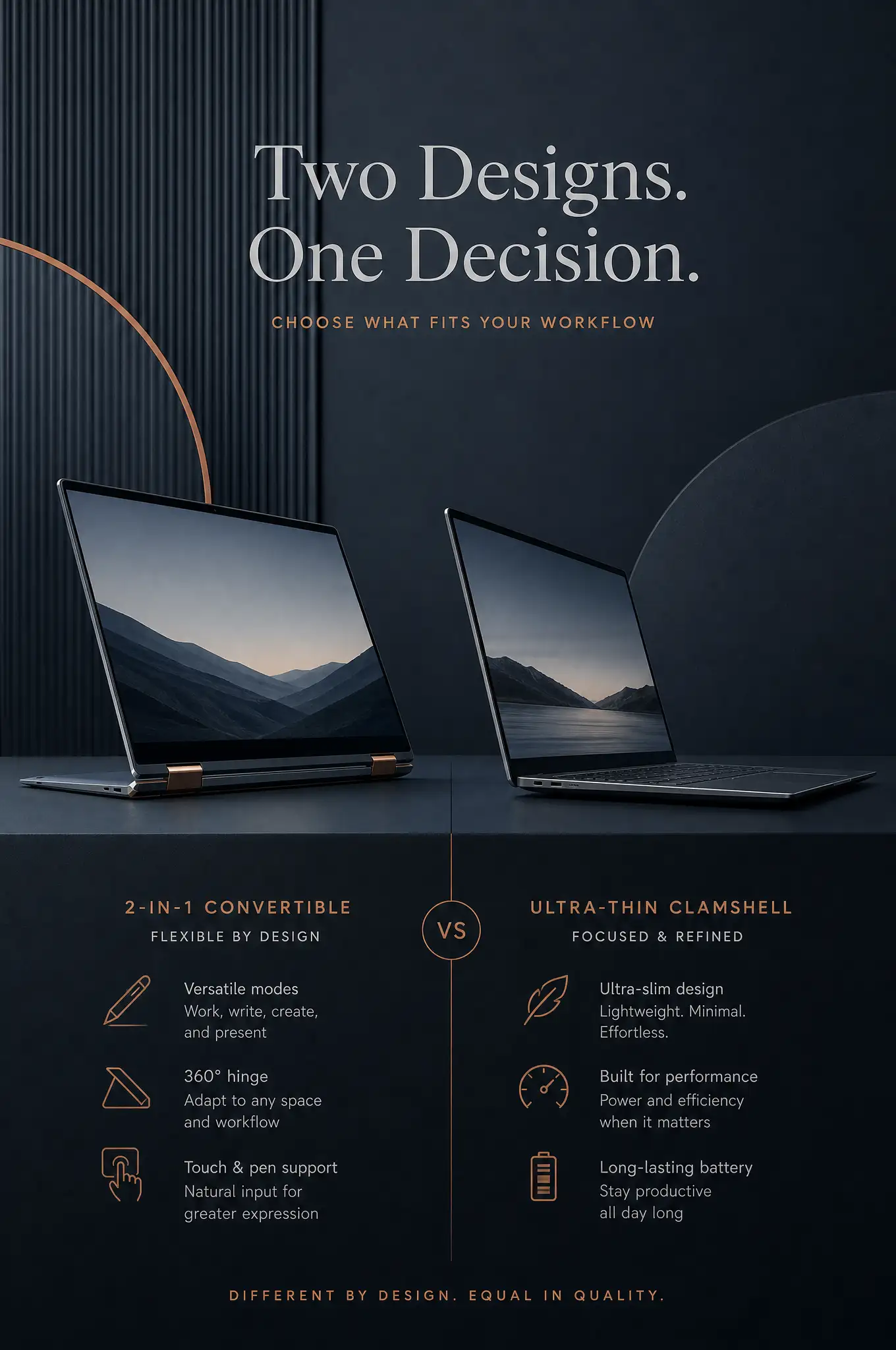
Premium Windows laptops have never been better. The Lenovo Yoga 9i and the ASUS Zenbook S16 both cost around $1,500, both run on the latest Intel or AMD silicon, and both are designed to compete directly with the MacBook Air while offering things Apple will not — touchscreens, convertible hinges, and OLED displays.
But they appeal to different buyers. The Yoga 9i is a 2-in-1 that wants to be your laptop, tablet, and everything in between. The Zenbook S16 is an ultra-thin clamshell that prioritizes portability and battery life above all else. After using both for work and entertainment, here is how they compare.
Design and Build
The Yoga 9i is the more striking laptop. The rounded edges, polished chrome hinges, and the speaker bar that runs the length of the hinge make it stand out in a coffee shop. The 360-degree hinge lets you flip the screen into tablet mode, tent mode for watching videos, or a flat presentation mode. The aluminum chassis feels substantial at 3.1 pounds, which is reasonable for a 14-inch convertible.
The Zenbook S16 takes the opposite approach — it disappears. At 2.65 pounds and 0.47 inches thick, it is one of the thinnest 16-inch laptops ever made. The Ceraluminum lid (a ceramic-infused aluminum) resists fingerprints and feels premium. It does not flex, fold, or convert — it is a laptop, and it does not apologize for it.
If you want a device that adapts to different scenarios, the Yoga wins. If you want the lightest possible laptop that still has a large screen, the Zenbook S16 is remarkable.
Display
The Yoga 9i’s 14-inch 2.8K OLED touchscreen is gorgeous. Colors are vibrant at 100% DCI-P3, blacks are truly black, and the 120Hz refresh rate makes scrolling feel fluid. The touchscreen is responsive and supports Lenovo’s active pen for note-taking and sketching. Brightness reaches 400 nits, which is fine indoors but struggles in direct sunlight.
The Zenbook S16’s 16-inch 3K OLED is even more impressive. The larger screen size makes a real difference for multitasking — two documents side by side, or a spreadsheet at full width. It also covers 100% DCI-P3 with 120Hz refresh. Peak brightness hits 550 nits, making it more usable outdoors. The screen is not a touchscreen, which keeps the weight down but limits interaction to keyboard and trackpad.
Both displays are excellent. The Yoga’s touchscreen adds versatility. The Zenbook’s larger, brighter panel is better for productivity.
Performance
The Yoga 9i uses Intel Core Ultra 9 285H with integrated Arc graphics. For office work, browsing, and media consumption, it flies. Lightroom and Photoshop run smoothly. But the integrated graphics struggle with anything beyond casual gaming or light video editing.
The Zenbook S16 uses AMD Ryzen AI 9 HX 370 with Radeon 890M integrated graphics. AMD’s integrated GPU is significantly faster than Intel’s — you can play esports titles at 60+ fps and edit 4K video without proxy files. The NPU also handles Windows Copilot+ AI features locally, from real-time captions to Studio Effects in video calls.
For CPU tasks, both are fast and responsive. For anything GPU-intensive, the Zenbook’s AMD silicon has a clear advantage.
Keyboard and Trackpad
Lenovo keyboards are legendary, and the Yoga 9i continues the tradition. The 1.5mm key travel is satisfying. The layout is clean with a full-size right Shift key (a pet peeve of mine that Lenovo gets right). The glass trackpad is precise and generously sized.
The Zenbook S16’s keyboard is good but not great — the slightly shallower 1.3mm travel is a concession to thinness. The trackpad is larger, which is nice for gestures, but the keyboard cannot match Lenovo’s typing experience.
If you write all day, the Yoga’s keyboard is a meaningful advantage.
Battery Life
The Zenbook S16’s 78Wh battery paired with the efficient AMD chip delivers 14 hours of real-world mixed use — web browsing, document editing, video streaming. It is all-day battery life without compromise.
The Yoga 9i’s 75Wh battery with Intel silicon manages 10 hours of similar use. Still a full workday, but noticeably less than the Zenbook. The OLED display at higher brightness drains battery faster on both machines.
The Zenbook wins on battery life, and the margin is significant — those extra four hours mean the difference between charging at 3 PM and leaving your charger at home.
Audio
The Yoga 9i has the best laptop speakers this side of a MacBook Pro. The rotating soundbar in the hinge — tuned by Bowers & Wilkins — produces clear, full sound with actual bass presence. Music sounds good. Movies sound immersive. Video calls are crisp.
The Zenbook S16’s Harman Kardon speakers are serviceable but unremarkable. They get loud enough for YouTube and Zoom calls, but music sounds thin and there is no bass to speak of.
For media consumption, the Yoga 9i’s speakers are a genuine differentiator.
Verdict
The Lenovo Yoga 9i is the more versatile machine. The convertible hinge, touchscreen, pen support, and excellent speakers make it a laptop, tablet, and media device in one. The keyboard is best-in-class. If you want one device that does everything and enjoy the flexibility of a 2-in-1, the Yoga 9i is hard to beat.
The ASUS Zenbook S16 is the better pure laptop. The larger, brighter OLED display and incredible portability make it the ideal machine for people who mostly work at a desk or on the go and do not need touch or tablet modes. The battery life is outstanding, and the AMD performance gives it more GPU muscle.
For versatility: Yoga. For portability and productivity: Zenbook.