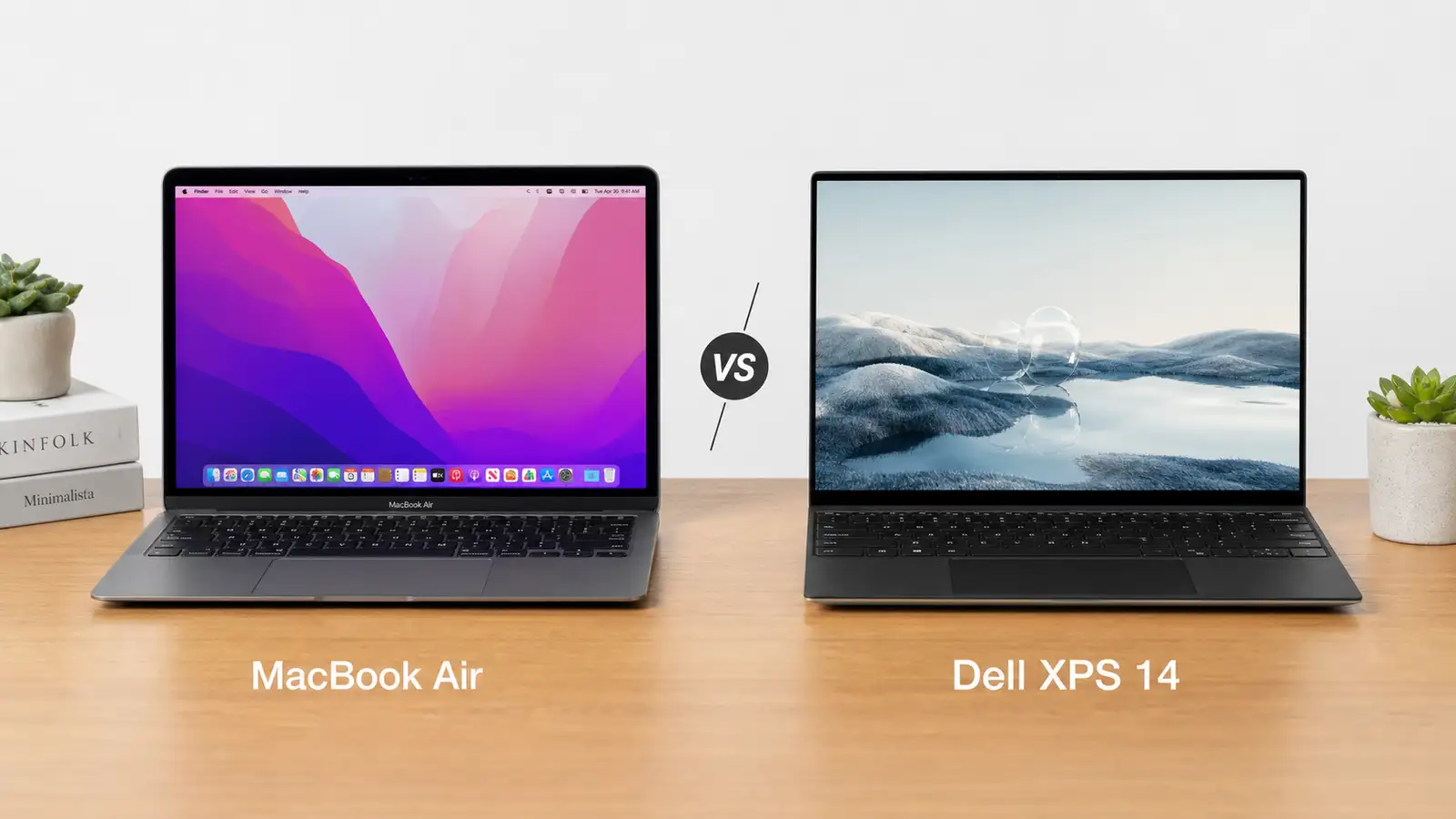
Apple’s M4 MacBook Air and Dell’s XPS 14 represent two very different philosophies of what a premium laptop should be. The MacBook Air is fanless, impossibly thin, and aggressively optimized for efficiency. The XPS 14 packs more ports, a higher-resolution display option, and a slightly heavier chassis that prioritizes raw thermal headroom.
Both launched in spring 2026 with significant upgrades: the MacBook Air jumped from M3 to M4, while the XPS 14 moved to Intel’s Lunar Lake platform. After three weeks of daily driving both machines, here’s where they stand.
Performance: Apple’s Efficiency vs Intel’s Raw Power
In synthetic benchmarks, the story is familiar. The M4 MacBook Air scores approximately 3,850 in Geekbench 6 single-core and 15,200 in multi-core. The Dell XPS 14 with Intel Core Ultra 7 258V scores roughly 3,100 single-core and 13,800 multi-core.
But benchmarks don’t tell the full story. The XPS 14 with its active cooling can sustain peak performance for longer — in a 30-minute Cinebench loop, the Dell drops to about 88% of its initial score while the fanless MacBook Air throttles to roughly 74%. For brief bursts (compiling code, opening apps), the MacBook Air feels faster. For sustained workloads (video exports, 3D rendering), the XPS 14 pulls ahead.
Winner: Tie. Different strengths for different users.
Battery Life: Not Even Close
This is where Apple’s architecture creates genuine daylight. In our standardized battery test (200-nit brightness, Wi-Fi browsing with 10 tabs refreshing every 30 seconds), the MacBook Air M4 lasted 16 hours and 12 minutes. The Dell XPS 14 with the 1080p display option lasted 11 hours and 47 minutes. With the 3.2K OLED display, that drops to 8 hours and 14 minutes.
For anyone who regularly works away from a power outlet, the MacBook Air’s advantage is meaningful. You can leave the charger at home for a full workday and not worry.
Winner: MacBook Air M4.
Display: Dell’s OLED Is Genuinely Better
The XPS 14’s optional 3.2K OLED panel (2880 x 1800, 120Hz) is the best display in the ultrabook category. It covers 100% of DCI-P3, hits 500 nits peak brightness in HDR, and the infinite contrast ratio of OLED makes dark-mode content look spectacular.
The MacBook Air’s 13.6-inch Liquid Retina display (2560 x 1664, 60Hz) is excellent by most standards — 500 nits sustained brightness, P3 wide color — but the 60Hz refresh rate and lack of HDR support feel dated in 2026 when you compare them side by side.
Winner: Dell XPS 14, provided you pay extra for the OLED upgrade ($300).
Build Quality and Portability
The MacBook Air remains the benchmark for thin-and-light construction. At 2.7 pounds and 0.44 inches thick, it disappears in a backpack. The unibody aluminum chassis has no flex points and the hinge is perfectly weighted for one-finger opening.
The XPS 14 weighs 3.8 pounds and measures 0.71 inches thick. It’s not heavy by Windows ultrabook standards, but it feels substantial next to the Air. The aluminum and glass construction is premium, but the hinge requires two hands to open and there’s noticeable keyboard deck flex if you press hard.
Winner: MacBook Air M4.
Ports and Connectivity
Dell wins decisively here. The XPS 14 includes three Thunderbolt 4 ports, one USB-A 3.2, a microSD card slot, and a 3.5mm headphone jack. The MacBook Air has two Thunderbolt 4 ports, MagSafe charging, and a headphone jack — and that’s it. If you regularly connect external displays, storage drives, or SD cards, the XPS 14 saves you from dongle life.
Winner: Dell XPS 14.
Verdict
The MacBook Air M4 is the better laptop for most people. Its battery life advantage alone makes it the safer recommendation, and macOS remains more polished than Windows 11 for day-to-day productivity.
But the Dell XPS 14 has clear wins for specific users: anyone who needs a great display for creative work, anyone who relies on USB-A peripherals, and anyone doing sustained CPU-intensive work where active cooling matters.
If you’re already in the Apple ecosystem, get the MacBook Air. If you’re platform-agnostic and value display quality above all else, the XPS 14 with the OLED upgrade is worth the premium. Either way, 2026 is a great year to be shopping for an ultrabook.