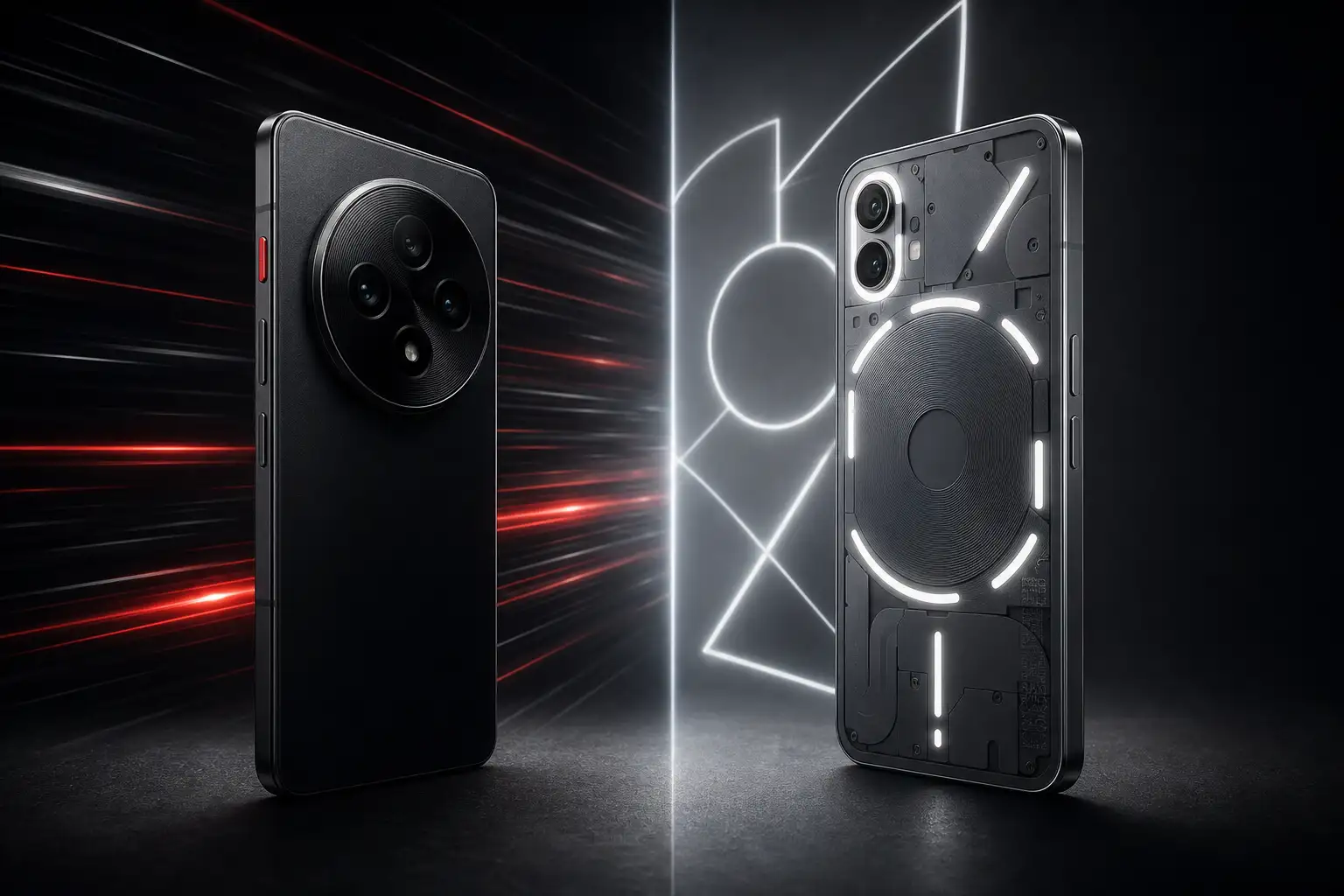
OnePlus used to be the flagship killer. Nothing wants to be the design icon. Both companies now sell phones in the $600 to $800 range, slotting in just below the Samsung Galaxy and Apple iPhone premium tier. The OnePlus 14 and Nothing Phone 3 represent the best each company can do, and they take very different approaches to winning your wallet.
I have been switching between both for the past few weeks. Here is what stands out.
Design and Build
The Nothing Phone 3 is impossible to ignore. The transparent back, the Glyph LED strips, the symmetrical bezels — it looks like nothing else on the market. The Glyph interface is more useful than you might expect: the lights pulse for notifications, act as a fill light for the camera, and even show a visual timer. It is still mostly a party trick, but it is a good party trick.
The OnePlus 14 is more conventional. The matte glass back and aluminum frame feel premium without drawing attention. OnePlus’s alert slider — a physical switch for silent, vibrate, and ring — remains the best hardware feature on any Android phone. The in-hand feel is excellent, especially on the vegan leather-backed green model.
Neither phone is small. The Nothing Phone 3 has a 6.7-inch display. The OnePlus 14 has a 6.82-inch display. Both are two-handed devices.
Display
OnePlus leads here. The 6.82-inch LTPO AMOLED panel runs at 1440p resolution with a 1-120Hz adaptive refresh rate. Peak brightness hits 4,500 nits in HDR content, which is absurdly bright — you can read the screen in direct sunlight without squinting.
The Nothing Phone 3 uses a 6.7-inch LTPO OLED at 1080p with 120Hz refresh rate. It is a good display: colors are accurate, the 120Hz refresh feels smooth, and the uniform bezels make content look framed. But 1080p at 6.7 inches means text is slightly less crisp than on the OnePlus, and peak brightness tops out around 1,600 nits. Fine for indoor use, less so outdoors.
If display quality is your priority, the OnePlus 14 wins clearly.
Performance
Both phones use the Snapdragon 8 Elite chip paired with 12GB or 16GB of RAM. Day-to-day performance is indistinguishable — both fly through apps, games, and multitasking without hesitation.
The difference is in sustained performance. OnePlus has a larger vapor chamber and a more aggressive cooling system. In a 20-minute Genshin Impact session at max settings, the OnePlus 14 maintained 58 fps average while the Nothing Phone 3 dropped to 51 fps after 10 minutes. The OnePlus also runs cooler to the touch.
For most people, both phones are fast enough. If you play demanding games regularly, the OnePlus has an edge.
Cameras
OnePlus partnered with Hasselblad again for the 14’s camera system. The main 50MP sensor produces natural colors and excellent dynamic range. The 64MP periscope telephoto with 3x optical zoom is sharp enough to crop further without losing detail. The ultrawide is fine but not class-leading.
Nothing’s camera system has improved dramatically since the Phone 1. The Phone 3’s 50MP main sensor uses a larger Sony IMX sensor than its predecessor, and the processing is more restrained — less sharpening, less saturation boosting. Photos look natural, though low-light performance trails the OnePlus. The 50MP telephoto does 2x optical zoom, and the ultrawide doubles as a macro lens.
The OnePlus 14 takes more consistently good photos. The Nothing Phone 3 takes photos that sometimes surprise you with how natural they look, and sometimes disappoint with noise in dim light. If you want a camera you can trust in any situation, get the OnePlus.
Software
OxygenOS 15 on the OnePlus 14 is clean, fast, and nearly bloat-free. OnePlus promises four years of Android updates and five years of security patches. The software feels like a lighter version of what you get on a Pixel, with a few useful additions like floating windows and an excellent gaming mode.
Nothing OS 3.0 on the Phone 3 is the most distinctive Android skin on the market. The monochrome icon pack, the dot-matrix design language, the custom widgets — it all coheres into an aesthetic that feels intentional rather than tacked on. Nothing promises three years of Android updates and four years of security patches.
If you want a unique, opinionated software experience, Nothing delivers. If you want something closer to stock Android with practical extras, OnePlus is the safer bet.
Battery
The OnePlus 14 has a 6,000mAh silicon-carbon battery — the largest in any mainstream flagship. It easily lasts two days of moderate use. 100W wired charging fills the phone in 30 minutes. 50W wireless charging is supported with a OnePlus charger.
The Nothing Phone 3 has a more conventional 5,000mAh battery that lasts a full day comfortably. 65W wired charging fills it in about 45 minutes. 15W wireless charging is supported but slow.
OnePlus dominates on battery life and charging speed. It is not close.
Verdict
The OnePlus 14 is the more complete phone. Better display, better cameras, vastly better battery life, and faster charging. It is the flagship killer OnePlus has been promising for years.
The Nothing Phone 3 is the more interesting phone. The design, the Glyph lights, and Nothing OS create an experience that feels fresh in a market full of glass rectangles. If you are bored with smartphones, Nothing will wake you up.
For most people, the OnePlus 14 is the better buy. But I would not blame anyone who picks the Nothing Phone 3 for the sheer joy of using something different.