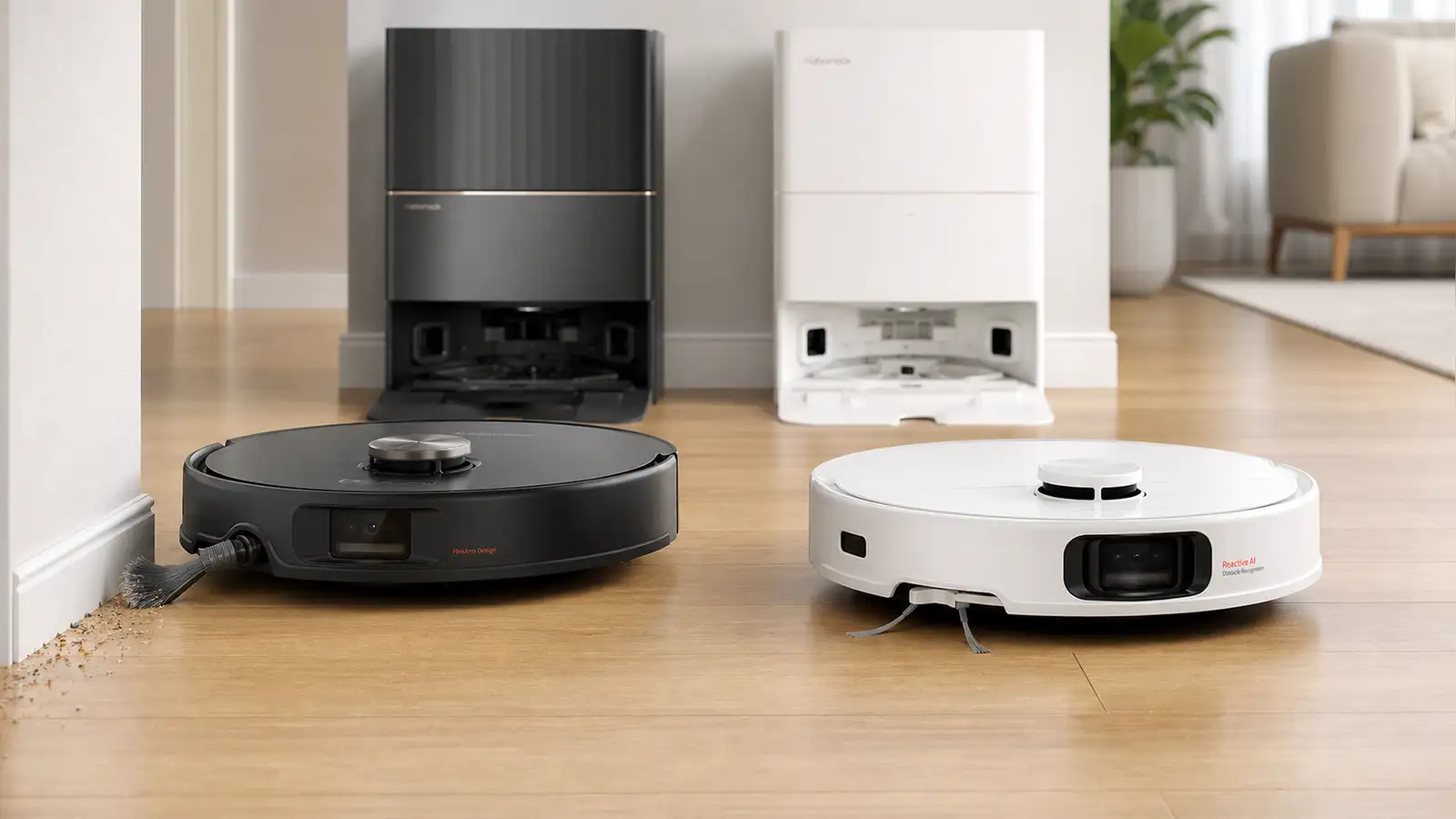
Two robot vacuums walk into your house. One costs $1,800. The other also costs $1,800. Both promise to vacuum, mop, empty themselves, wash their own mop pads, and navigate around dog toys without getting tangled. By the spec sheet, they’re nearly identical. In practice, they make very different tradeoffs, and which one you should buy depends almost entirely on what kind of floors you have and how much you care about edge cleaning.
Here’s how the Roborock S8 MaxV Ultra and DreameBot X40 Ultra compare after testing both across hardwood, tile, carpet, and the chaos of a household with two shedding dogs.
Both machines represent the absolute top tier of what robot vacuums can do in mid-2026. Neither is perfect, but both get closer to “set it and forget it” than anything we tested two years ago.
Cleaning Performance: Vacuum
Both robots use around 6,000 Pa of suction, which is more than enough for hard floors and adequate for medium-pile carpet. Neither will replace an upright vacuum for deep carpet cleaning, but that’s true of every robot vacuum on the market.
The Roborock S8 MaxV Ultra uses a dual rubber roller brush system that’s essentially unchanged from the S7 generation. It resists hair tangling well — if you have long-haired humans or pets in the house, you’ll spend less time cutting hair off the brush than you would with most competitors. On hard floors, debris pickup is thorough. On carpet, the dual rollers agitate enough to pull embedded dust and pet hair out of medium-pile carpet, though deep-pile still requires multiple passes.
The DreameBot X40 Ultra uses a single rubber brush with a comb-like anti-tangle design. It’s slightly less effective on carpet than the Roborock’s dual-roller setup, but the difference is marginal — we’re talking about a 5-8% difference in pickup on medium-pile carpet in our test, measured by weight of debris collected after a standardized pass. On hard floors, performance is essentially identical.
The bigger differentiator is edge cleaning. The DreameBot extends a side brush and mop pad outward when it detects edges and corners, reaching into areas the Roborock’s round body misses. If you have baseboards that collect dust or kitchen corners where debris accumulates, the DreameBot’s extending arm makes a visible difference. The Roborock handles edges adequately but leaves a thin uncleaned strip along walls and in corners that you’ll need to address manually every few weeks.
Mopping
This is where the two robots diverge most sharply.
The Roborock S8 MaxV Ultra uses vibrating mopping pads that oscillate at up to 4,000 times per minute. It applies consistent downward pressure and uses the onboard water tank to keep pads damp. For daily maintenance mopping — light dust, paw prints, water spots — it does the job. It won’t remove dried-on coffee spills or muddy footprints without multiple passes, and even then, results are mixed.
The DreameBot X40 Ultra uses rotating mop pads that spin at 200 RPM with 10N of downward pressure. This is a fundamentally different approach. The spinning action scrubs rather than vibrates, and in our tests, it removed dried ketchup, coffee rings, and light mud significantly better than the Roborock’s vibrating system. The DreameBot also lifts its mop pads higher when transitioning to carpet (12mm vs 8mm on the Roborock), which matters if you have thick rugs or carpet transitions.
Both robots return to their docks to wash mop pads mid-cycle, refill water, and resume cleaning. Both use hot water washing (the Roborock at 60°C, the DreameBot at 58°C) and hot air drying to prevent mildew. In terms of maintenance, they’re comparable — you’ll need to refill the clean water tank and empty the dirty water tank roughly once a week, more often if you run daily mopping cycles.
Navigation and Obstacle Avoidance
Both robots use LiDAR mapping combined with RGB cameras for obstacle recognition. Both will identify and avoid pet waste, cables, socks, and shoes. Both produce accurate floor maps within the first cleaning run and allow room-by-room scheduling through their respective apps.
The practical difference: the Roborock’s Reactive AI 3.0 obstacle avoidance is slightly more conservative. It will give a wider berth to detected objects, which means it sometimes leaves uncleaned areas around things it identified as obstacles. The DreameBot’s obstacle avoidance is more aggressive — it navigates closer to detected objects, which means better coverage but slightly higher risk of getting tangled in cables it misidentified.
Both are a massive improvement over the bumper-car navigation of 2022-era robots. You can run either one in the dark and not worry about it eating a phone charger.
The Docks
The docks are where you’ll interact with these machines most, and they’re where the ownership experience diverges.
The Roborock S8 MaxV Ultra dock is tall and boxy — about 19 inches high and 17 inches wide. It auto-empties the dustbin into a bag that holds about 7 weeks of debris for most households. It refills the robot’s water tank, washes the mop pads, and dries them. The water tanks are accessible from the top. The overall build feels premium and the dock is easy to clean, with removable components for the mop washing tray.
The DreameBot X40 Ultra dock is slightly shorter but wider — about 17 inches high and 20 inches wide. It holds a larger dust bag (rated for 10 weeks), and its water tanks are front-access rather than top-access, which makes refilling slightly more awkward but also means you can tuck the dock under a lower shelf. The DreameBot dock also includes a detergent dispensing system that automatically adds cleaning solution to the mop water, something the Roborock dock lacks.
Neither dock is small. Both require roughly the same spatial footprint as a medium-sized kitchen trash can. If you live in an apartment where floor space is at a premium, measure before you buy.
App and Smart Features
Both apps are mature and functional. Roborock’s app has a slight edge in polish — the UI is cleaner, scheduling is more intuitive, and multi-floor mapping works more smoothly. Dreame’s app is fully capable but occasionally buries settings behind extra menu taps.
Both integrate with Alexa, Google Assistant, and Siri Shortcuts. Both support room-specific cleaning commands (“clean the kitchen”), and both let you set different suction and mopping intensity levels per room. Both also offer pet-specific features: the Roborock can be set to avoid pet bowls and beds automatically, while the DreameBot includes a pet patrol mode that will seek out and focus on areas where pets spend the most time.
The Roborock has one practical advantage: its “Hello Rocky” voice assistant can respond to commands without going through Alexa or Google, which means it works during internet outages. The DreameBot requires an active connection for voice control unless you’re using it through a separate smart speaker.
Firmware updates have been frequent for both devices, with Roborock averaging an update every 6-8 weeks and Dreame every 8-10 weeks. Both companies have added meaningful features post-launch — Roborock added pet patrol in a March 2026 update, and Dreame added a “deep edge” cleaning mode in May that extends the arm further into corners.
Noise and Runtime
On standard suction, both robots run at around 55-58 decibels, comparable to a quiet conversation. On max suction (which you’d use for carpet), the Roborock peaks at 65 dB and the DreameBot at 67 dB — both noticeably louder but not disruptive enough to prevent watching TV in the same room. The mopping cycle is quieter on both, around 48-52 dB, since the vacuum motor runs at lower power.
Runtime is comparable: about 120-140 minutes on standard suction for both, enough to clean roughly 2,000 square feet on a single charge. Both will automatically return to the dock, recharge, and resume if the cleaning area exceeds battery capacity. In practice, unless your home is larger than about 3,000 square feet of cleanable floor space, neither will need to recharge mid-cycle.
The Verdict
These are both excellent robots. Your choice comes down to what kind of floors dominate your home and whether you’re willing to trade edge cleaning for slightly better carpet performance.
If you have mostly carpet with some hard floors, the Roborock S8 MaxV Ultra’s dual-roller brush and more conservative navigation make it the better pick. The carpet pickup difference is real, and the more cautious obstacle avoidance means fewer rescue missions. The vibrating mop pad will handle light hard-floor maintenance without issues, and the taller dock, while visually imposing, is easier to refill from above without stooping.
If you have mostly hard floors — hardwood, tile, laminate — the DreameBot X40 Ultra’s extending edge brush, spinning mop pads, and detergent system make it the stronger performer. The mopping superiority is especially noticeable if you have a kitchen or dining area that sees regular spills. The front-access water tanks take some getting used to, but the shorter dock height means more placement options.
If your home is a roughly even split between carpet and hard floors, the edge goes to DreameBot for the extending arm and better mopping, with the understanding that you’ll run it on max suction for carpeted rooms and accept slightly less deep-cleaning performance in exchange for cleaner edges everywhere else.
A few practical notes that specs don’t capture: both robots can navigate under furniture with about 4 inches of clearance, but the DreameBot’s slightly lower profile (3.8 inches vs the Roborock’s 4.1 inches) means it fits under more sofas and beds. Both will occasionally get confused by highly reflective surfaces like polished black tile or mirrored closet doors — this is a LiDAR limitation, not a brand-specific issue. And both will need their sensors wiped down every couple of weeks, more often if you have pets that shed heavily.
Neither machine will make you regret the purchase. Both are genuinely hands-off after the first setup — you’ll go weeks without thinking about your floors, which is the whole point of spending $1,800 on a robot that cleans them. The differences are real but narrow, and both companies update their software regularly enough that today’s edge cases tend to become tomorrow’s solved problems. If you’re coming from an older robot vacuum, the jump to either of these will feel less like an upgrade and more like a completely different product category.