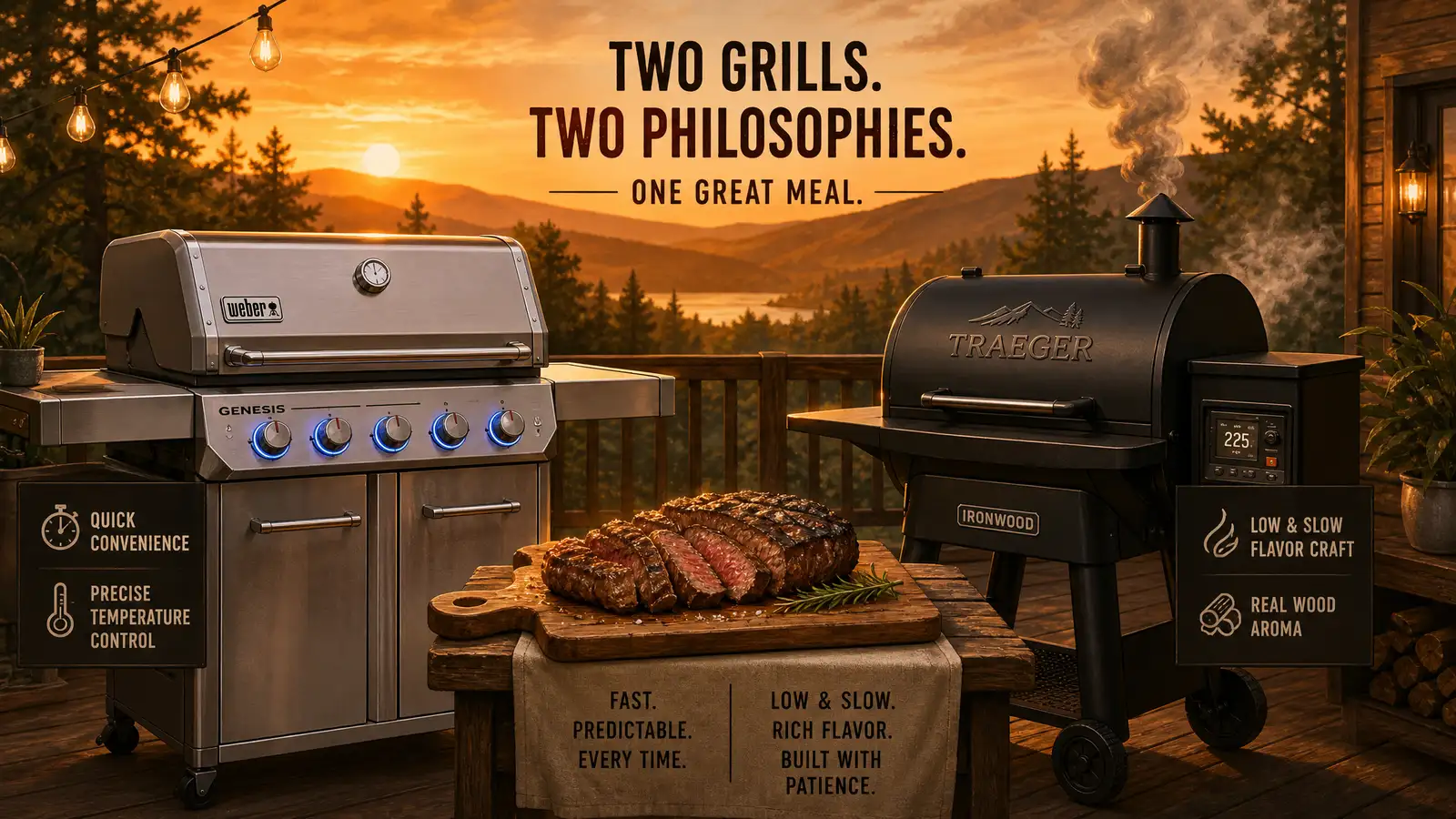
The backyard cooking debate has two camps: gas grill people and pellet smoker people. Gas grill people want dinner on the table in 20 minutes. Pellet smoker people want to set a brisket at 8 AM, monitor it from their phone, and serve it at 6 PM with a smoke ring that makes neighbors jealous.
The Weber Genesis E-435 and Traeger Ironwood 885 represent the best of each philosophy. Both cost around $1,500. Both are built to last. And both will produce better food than the grill you got at a big-box store. But they cook very differently, and picking the wrong one for your lifestyle means an expensive piece of patio furniture you never use.
How They Cook
The Weber Genesis is a gas grill. Four burners produce 48,000 BTUs of heat across 646 square inches of cooking surface. You turn a knob, it gets hot, you put food on the grates, and dinner happens. The sear station burner hits 900 degrees for steakhouse-quality crusts. The cooking is fast, direct, and predictable.
The Traeger Ironwood is a pellet grill. A motorized auger feeds compressed wood pellets into a firepot, where they smolder and produce smoke. A fan circulates the smoke and heat around the cooking chamber like a convection oven. The cooking is slow, indirect, and smoky. Temperature control is precise — you set 225 degrees on the touchscreen or phone app, and the Ironwood holds it within 5 degrees for hours.
Gas grilling is fast and hot. Pellet smoking is slow and low. The Genesis does burgers and steaks better. The Ironwood does ribs, brisket, and pulled pork better.
Flavor
Pellet smoking produces deeper, more complex flavor. The smoke from real hardwood pellets — hickory, mesquite, apple, cherry — penetrates meat over hours of low-temperature cooking. A brisket cooked on a Traeger for 12 hours with mesquite pellets tastes like it came from a Texas barbecue joint.
Gas grilling produces clean, direct heat flavor. The Maillard reaction — the browning that creates crusty, savory goodness — happens fast on hot grates. A steak seared on the Genesis at 900 degrees develops a crust that no pellet grill can match. But there is no smoke character unless you add a smoker box.
If flavor complexity is your priority, the Traeger wins. If you want the pure taste of well-cooked meat with a perfect sear, the Weber delivers.
Convenience
The Weber Genesis is the most convenient outdoor cooking appliance ever made. Preheat takes 10 minutes. Cooking takes 10-20 minutes for most meals. Cleanup involves brushing the grates and emptying the grease tray. You can grill dinner on a Tuesday after work without planning ahead.
The Traeger Ironwood requires more time but less attention. You still need to load pellets, preheat for 15-20 minutes, and plan for cooking times measured in hours rather than minutes. But once the food is on, you can walk away — the Ironwood’s Wi-Fi controller monitors temperature and sends alerts to your phone. You can run errands, watch a movie, or take a nap while it cooks.
The Genesis is for people who want to cook quickly and move on. The Ironwood is for people who want to make cooking an event without standing over a fire all day.
Technology
Traeger’s WiFire technology is the killer feature. The Ironwood connects to your home Wi-Fi and the Traeger app, where you can monitor meat probe temperatures, adjust the cooking temperature, and access thousands of recipes with step-by-step instructions. The app tells you when to wrap the brisket, when to bump the temperature, and when to pull it off. It turns barbecue — traditionally a craft learned through trial and error — into a guided experience.
Weber’s Genesis includes the Weber Connect smart grilling hub, which provides temperature monitoring and step-by-step cooking guidance on your phone. It is useful for timing steaks and roasts, but it is less transformative than Traeger’s system because gas grilling simply requires less monitoring.
Traeger’s technology is a genuine differentiator. Weber’s is a nice-to-have.
Versatility
The Weber Genesis is more versatile for everyday cooking. Beyond burgers and steaks, it handles vegetables, fish, pizza on a stone, and breakfast on a griddle. The side burner lets you simmer sauces or boil corn while the main grates handle the protein.
The Traeger Ironwood can grill at high temperatures (up to 500 degrees) in addition to smoking, but direct grilling on a pellet grill never matches the sear of a gas grill. The Ironwood is outstanding for smoking, roasting, and baking — whole chickens, reverse-seared steaks, smoked salmon, and even desserts — but it is less suited for quick, high-heat cooking.
For year-round versatility, the Genesis covers more cooking styles. For the depth of smoked flavor, the Ironwood does one thing extraordinarily well.
Verdict
Buy the Weber Genesis if you want to grill dinner quickly after work, host impromptu cookouts, and cook a wide variety of foods without planning ahead. It is the most practical outdoor cooking appliance ever made.
Buy the Traeger Ironwood if you want to make barbecue that rivals a restaurant, enjoy the process of slow cooking, and appreciate technology that guides you through multi-hour cooks. The WiFire system makes ambitious barbecue accessible to beginners, and the results speak for themselves.
If you can only have one, the Genesis is more versatile. If you have the space and budget for both, they complement each other perfectly — one for Tuesday burgers, one for Sunday brisket.