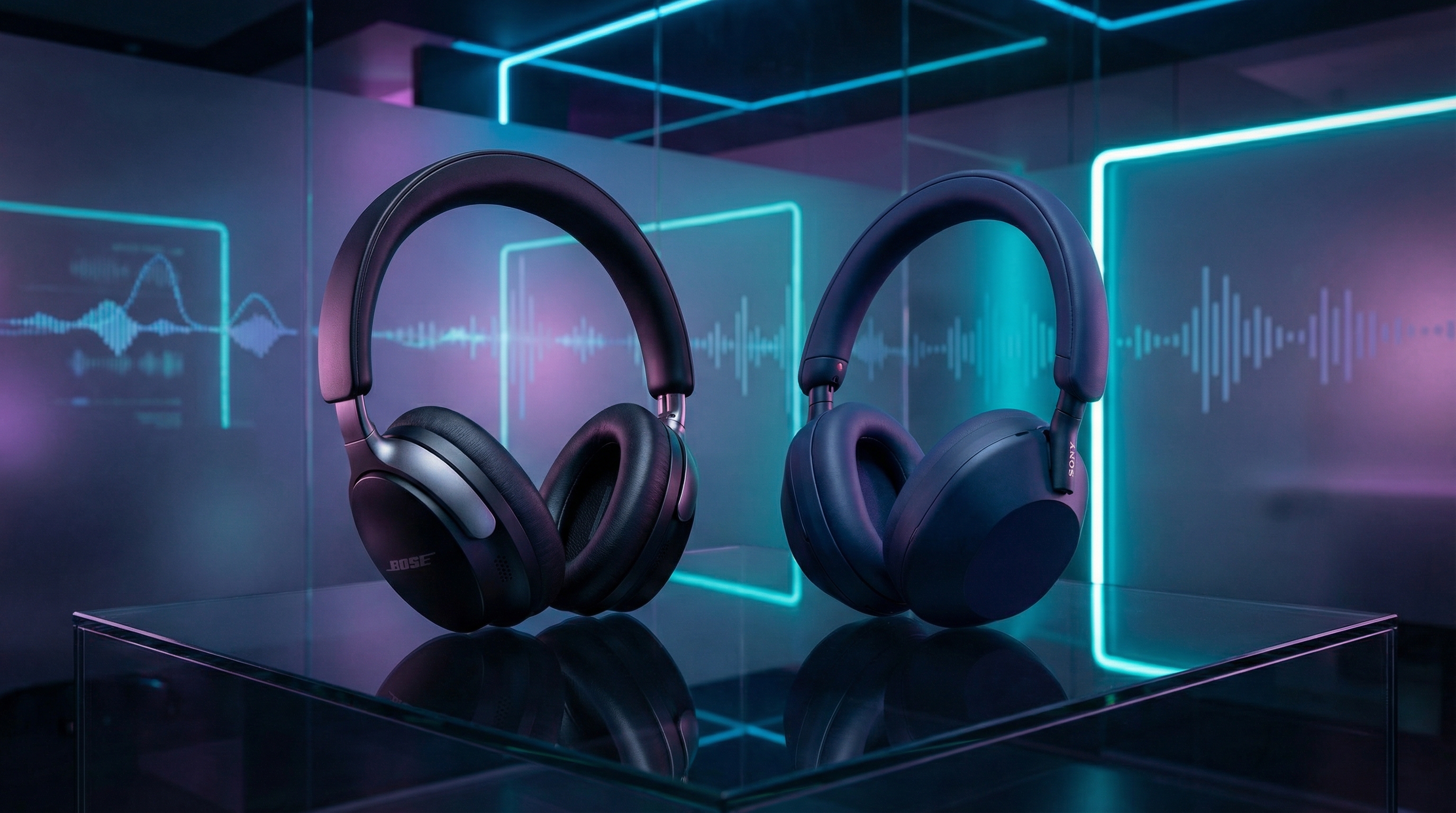
For years, the conversation around premium noise-cancelling headphones has centered on two brands. Bose pioneered the category and built a reputation on comfort and natural-sounding cancellation. Sony pushed the technology forward with aggressive feature sets and audiophile-grade sound processing. The Bose QuietComfort Ultra represents Bose’s most ambitious attempt to reclaim the throne, while the Sony WH-1000XM5 remains the benchmark that every competitor measures itself against. I tested both headphones extensively over five weeks, and the results were closer than I expected.
Design and Comfort
The QuietComfort Ultra looks like a Bose headphone, and I mean that as a compliment. The design language is familiar. rounded ear cups, a padded headband, and a clean profile that does not scream for attention. Bose refined the materials this time around. The protein leather ear cushions feel softer against the skin, and the clamping force is perfectly calibrated. These are headphones you can wear for an entire workday without any hotspots or discomfort.
Sony’s WH-1000XM5 broke from the XM4’s design in significant ways. The headband is a single piece of synthetic leather stretched across a flexible frame, and the ear cups no longer fold flat. It looks more modern and minimal than its predecessor, but the fit is slightly different. Some people with larger heads report that the XM5 feels tighter than the XM4 did. For my head size, both the XM5 and the QC Ultra were comfortable for hours, but the Bose had a slight edge in long-session comfort.
Build Comparison
| Specification | Bose QC Ultra | Sony WH-1000XM5 |
|---|---|---|
| Weight | 250g | 250g |
| Foldable | Yes (flat) | No |
| Carrying Case | Hard shell | Hard shell |
| Water Resistance | No | IPX4 |
| Headband Material | Cushioned synthetic | Synthetic leather |
| Ear Cushion | Protein leather | Synthetic leather |
Weight is identical, which is interesting. Sony wins on practical durability with IPX4 water resistance. a genuine advantage for gym use or rainy commutes. Bose counters with the ability to fold flat, which makes the QC Ultra slightly more travel-friendly despite similar case sizes.
Sound Quality
Here is where Bose made its biggest leap. The QuietComfort Ultra sounds notably better than any previous Bose headphone. The tuning is richer and more detailed, with a low end that extends deep without overwhelming the midrange. Instruments are well-separated in the stereo field, and vocals sit forward in the mix with excellent clarity. Bose’s new Immersive Audio mode adds a spatial dimension that widens the soundstage considerably. It is not just a gimmick. on well-produced recordings, the effect enhances the listening experience.
The XM5 has been my reference for wireless headphone sound quality for over a year. Sony’s DSEE Extreme processing does a remarkable job upscaling compressed audio, and the overall tonality is warm, engaging, and musical. Bass response is punchy and satisfying, mids are smooth, and treble is detailed without being harsh. LDAC support means you can push high-resolution audio wirelessly from compatible sources, and the difference over standard Bluetooth codecs is noticeable.
Comparing them directly is a study in sonic preferences. The QC Ultra has a slightly wider soundstage and more natural instrument separation, especially with Immersive Audio enabled. The XM5 has warmer bass and more forward mids, which makes vocals and pop music feel more intimate and engaging. For classical, jazz, and acoustic music, I preferred the Bose. For hip-hop, electronic, and rock, the Sony felt more energetic.
Sony still has the edge in codec versatility. LDAC and aptX support mean the XM5 can receive higher-quality wireless audio from Android devices and dedicated audio players. The QC Ultra supports aptX Adaptive and AAC, which covers most use cases but does not match LDAC’s theoretical bandwidth ceiling.
Noise Cancellation
This category is the entire reason these headphones exist, and both deliver at an level. The QuietComfort Ultra uses a new processing chip that Bose developed specifically for this product. The noise cancellation is the best Bose has ever shipped. Low-frequency sounds. airplane engines, train rumble, air conditioning hum. are virtually eliminated. Mid-frequency cancellation is strong, reducing conversation and office noise to a whisper. High-frequency sounds are softened but not completely removed, which is typical of most ANC implementations.
Sony’s V1 Integrated Processor on the XM5 has been the industry benchmark since launch. It handles the same range of frequencies with similar effectiveness. In my testing, the two headphones were remarkably close in raw cancellation performance. I ran them side-by-side on three flights, two subway commutes, and in a noisy open-plan office. The differences were marginal enough that environment and fit had more impact than the underlying technology.
Where Bose pulls slightly ahead is in the quality of the cancellation experience. The QC Ultra produces less of the ear-pressure sensation that some people find uncomfortable with aggressive ANC. The cancellation feels lighter and more transparent while achieving similar objective noise reduction. This is a subjective preference, but in conversations with other testers, the Bose consistently scored higher on comfort during cancellation.
Transparency modes tell a different story. Sony’s Ambient Sound Control offers twenty levels of transparency, from barely-there to full passthrough. The sound is clear and usable at every level. Bose offers fewer granularity options but its Aware mode sounds incredibly natural. like you are not wearing headphones at all. For casual awareness of your surroundings, Bose wins. For precise control over how much ambient sound you want, Sony wins.
Battery Life
Sony maintains its advantage here. The XM5 delivers around 28 to 30 hours of playback with ANC engaged, consistently hitting close to its 30-hour claim. Quick charging is efficient. three minutes gives you three hours of playback, which is enough to rescue a dead battery before a flight.
The QC Ultra comes in at roughly 22 to 24 hours with ANC, or less if you use Immersive Audio mode, which draws additional power. That is still plenty for most people, but the gap is noticeable if you travel frequently or dislike charging routines. Quick charging gives approximately 2.5 hours from a 15-minute charge.
Both headphones charge via USB-C, and both include auto-off features to conserve battery when not in use. Sony’s wear sensor pauses music and reduces power draw when you remove the headphones. Bose relies on a motion sensor that triggers standby mode after inactivity.
Connectivity and App Experience
The XM5 connects via Bluetooth 5.2 with multipoint support for two simultaneous devices. Sony’s Headphones Connect app is feature-rich, offering parametric EQ, adaptive sound control that adjusts ANC based on detected activity, speak-to-chat that pauses music when you start talking, and detailed customization of touch controls. The app can feel overwhelming at first, but the depth of control is appreciated once you learn the layout.
The QC Ultra uses Bluetooth 5.3 and also supports multipoint connection. Bose’s app is cleaner and more streamlined, with a focus on simplicity. EQ options are limited to preset modes and a basic adjustable curve. You can toggle Immersive Audio, adjust cancellation levels, and manage device connections. What Bose lacks in granular customization, it makes up for in usability. everything is two taps away.
Both headphones support voice assistants. Sony works with Google Assistant and Amazon Alexa. Bose supports Google Assistant and Alexa as well, with Siri accessible through your connected phone. Neither has a clear advantage here.
For multipoint reliability, both performed well in my testing. Switching audio from a laptop to a phone and back was seamless on both, though Sony occasionally took an extra second to complete the handoff.
Call Quality
Microphone performance is important for anyone who takes calls on headphones, and both companies invested in this area. The XM5 uses four beamforming microphones with AI-based noise reduction. Call quality is excellent in most environments. Voices come through clearly, and the AI processing does a respectable job filtering out steady background noise like cafe chatter or air conditioning.
The QC Ultra matches this performance with its own microphone array and wind-rejection technology. In side-by-side call tests, recipients could not reliably distinguish between the two headphones. Both struggled equally in very windy outdoor conditions, which remains a challenge for all wireless headphones.
The Verdict
The Bose QuietComfort Ultra edges out the Sony WH-1000XM5 as my overall recommendation. The combination of class-leading comfort, slightly more natural noise cancellation, Immersive Audio that enhances music listening, and a polished user experience makes it the more complete package in 2025.
Sony’s WH-1000XM5 remains an outstanding headphone and arguably the better value. It offers longer battery life, superior codec support with LDAC, more granular app customization, and water resistance that the Bose lacks. If you prioritize battery endurance, use Android with LDAC-compatible music sources, or need weather resistance, the XM5 is the smarter buy.
The margin between these two headphones is thin. Both deliver premium sound, exceptional noise cancellation, and comfortable all-day wear. You will be happy with either. But if forced to pick one for the broadest range of listeners and use cases, the QuietComfort Ultra’s refinement in comfort and cancellation quality gives it the narrowest of victories.