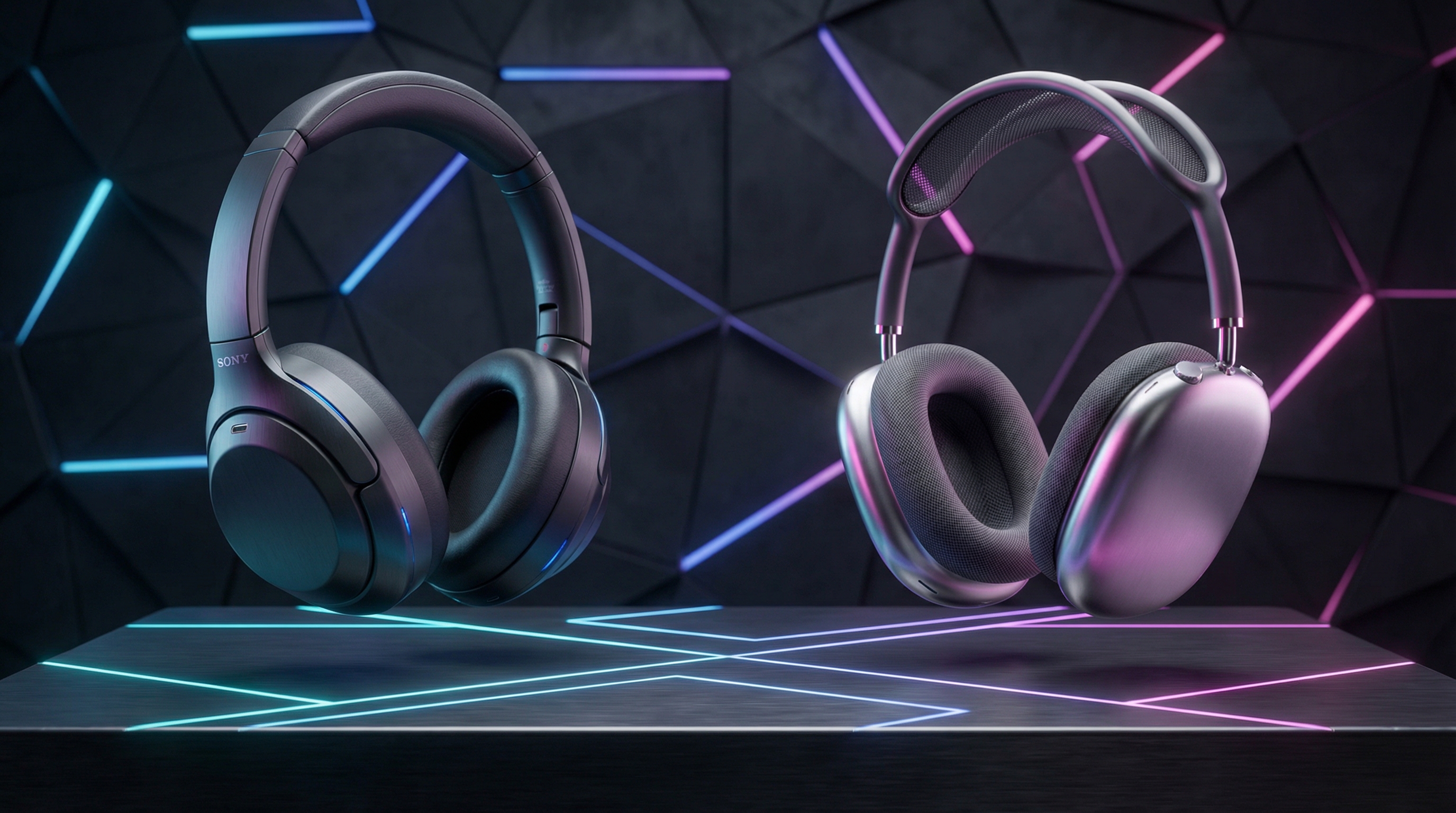
Flagship noise-cancelling headphones have become essential gear for anyone who values focus and high-fidelity audio. Sony and Apple both released their latest contenders in recent months, and they represent two radically different philosophies in product design. The WH-1000XM6 continues Sony’s relentless iteration on what many consider the gold standard of wireless ANC. The AirPods Max 2, meanwhile, doubles down on Apple’s premium hardware vision with tighter ecosystem integration. I spent four weeks testing both across commutes, flights, office sessions, and late-night listening. Here is what I found.
Design and Build
Sony made meaningful changes to the XM6 chassis. The headband is thinner and lighter, wrapped in a soft-touch synthetic leather that resists sweat better than before. Ear cups use memory foam with a cooling gel layer, which helped notably during longer sessions in warm weather. The overall silhouette stays minimal and understated. Sony clearly wants these to disappear on your head rather than make a fashion statement.
Apple went the opposite direction. The AirPods Max 2 retains the aluminum ear cups and stainless steel headband frame from its predecessor. It looks and feels like a piece of industrial art. The weight difference is quickly noticeable, though. At roughly 385 grams, the Max 2 is substantially heavier than the XM6 at around 245 grams. That gap matters over long listening sessions. After three hours on a transatlantic flight, the Max 2 started to press uncomfortably on the top of my head, while the XM6 remained barely noticeable.
Key Specifications
| Specification | Sony WH-1000XM6 | AirPods Max 2 |
|---|---|---|
| Weight | ~245g | ~385g |
| Driver Size | 40mm | 40mm |
| Foldable | No | No |
| Water Resistance | IPX4 | IPX4 |
| Case | Hard shell | Smart Case |
| Colors | Black, Silver, Midnight Blue | Space Gray, Silver, Midnight, Starlight, Blue |
Apple offers more color options, and the build quality is objectively premium. But Sony wins on comfort by a considerable margin. If you wear headphones for hours daily, that weight difference is not trivial.
Sound Quality
This is where things get interesting. Sony upgraded to a new 40mm carbon fiber composite driver in the XM6, and the improvement over the XM5 is audible. Bass response is tighter and more controlled, mids are warmer without being muddy, and the high-frequency detail retrieval is noticeably better. LDAC support means you can stream high-resolution audio from compatible devices, and the difference between LDAC and standard AAC is audible on well-mastered tracks.
The AirPods Max 2 sounds phenomenal. Apple’s computational audio processing does remarkable things with the H2 chip. Spatial Audio with dynamic head tracking creates an immersive soundstage that feels closer to open-back headphones than any closed-back competitor I have tested. The bass is punchy without bleeding into the mids, and vocals have a presence and clarity that is hard to fault.
Where they differ is in tuning philosophy. Sony leans slightly warm and bass-forward out of the box, though the Headphones Connect app lets you reshape the sound profile extensively. Apple goes for a more neutral, studio-monitor-like presentation. Neither approach is wrong. it depends on your library and preferences.
One significant advantage for Sony: the XM6 supports LDAC, aptX Adaptive, and AAC codecs. The AirPods Max 2 remains limited to AAC and Apple Lossless via the Lightning-to-USB-C cable. For Android users or anyone who cares about wireless high-res audio, this is a decisive factor.
Noise Cancellation
Both headphones deliver class-leading ANC, but the implementation differs. Sony uses its Integrated Processor V2, which analyzes ambient sound across eight microphones and adapts cancellation in real time. The result is remarkably effective across the frequency spectrum. Low-frequency drone from airplane engines is nearly eliminated. Mid-range office chatter is reduced to a faint murmur. High-frequency sounds like keyboard clicks are softened considerably.
Apple’s ANC is equally impressive in raw performance. The H2 chip processes noise cancellation 48,000 times per second, and it shows. In my side-by-side testing on a subway, both headphones reduced ambient noise to roughly the same degree. The difference is in how they feel. Sony’s ANC occasionally creates a very slight pressure sensation in the ear canal during heavy cancellation. Apple’s implementation feels more natural and transparent, even at maximum strength.
Transparency mode is another point of comparison. Apple’s transparency is the best in the business. it sounds so natural that you forget the headphones are on. Sony’s ambient sound mode is good but not quite as seamless. Voices come through clearly, but there is a subtle digital quality to the passthrough.
For adaptive ANC that adjusts automatically based on your environment, both perform well. Sony offers more granular control through its app, letting you set precise levels and create location-based presets. Apple keeps things simple with a toggle between ANC, transparency, and off.
Battery Life and Charging
Sony claims up to 40 hours of battery life with ANC enabled on the XM6, and in my testing I consistently hit around 36 to 38 hours. That is outstanding. A full day of continuous use barely dents the battery indicator. Quick charging gives you roughly 5 hours of playback from a 10-minute charge.
The AirPods Max 2 improved its battery life to approximately 30 hours with ANC, up from 20 on the original. I measured around 27 to 28 hours in practice. That is a major improvement but still trails Sony by a full workday of listening. The Max 2 now charges via USB-C, which is a welcome change. Quick charging performance is similar to Sony. about 5 hours from a short charge.
Neither headphone has a power button in the traditional sense. Sony uses a wear sensor plus a physical switch. Apple relies on the Smart Case to trigger a low-power state. Both approaches work, though I occasionally found the Max 2 draining overnight if I forgot to stow it in the case.
Connectivity and Features
The XM6 runs Bluetooth 5.4 with multipoint connection, meaning you can stay connected to two devices simultaneously and switch audio between them seamlessly. This is essential for anyone who moves between a laptop and phone throughout the day. The Headphones Connect app offers deep customization: parametric EQ, adaptive sound control, speak-to-chat, and DSEE Ultimate upscaling for compressed audio files.
AirPods Max 2 runs Bluetooth 5.3. Multipoint is handled through Apple’s ecosystem. seamless handoff between iPhone, iPad, and Mac works beautifully, but it requires Apple devices. Connecting to a Windows laptop or Android phone works via standard Bluetooth, but you lose features like Spatial Audio with head tracking, automatic switching, and Siri integration.
Apple has one killer feature that Sony cannot match: lossless audio via USB-C. When plugged into an Apple device with a cable, the Max 2 can play Apple Music Lossless tracks at full quality. Sony cannot do wired lossless playback in the same way, though LDAC wireless gets close.
Other notable features on the XM6 include Google Assistant and Alexa support, customizable touch controls, and an auto-pause wear sensor. The Max 2 offers Find My integration, personalized Spatial Audio using TrueDepth camera calibration, and the Digital Crown for volume control. which remains one of the most satisfying physical controls on any headphone.
Call Quality
Sony improved its microphone array on the XM6, and it shows. Voice pickup is clear and focused, with AI-driven noise reduction filtering out background sound effectively. I took calls from a busy coffee shop and a windy park, and callers reported minimal interference.
The AirPods Max 2 is also excellent for calls, particularly within the Apple ecosystem. The beam-forming microphones isolate your voice well, and the computational processing smooths out environmental noise. In quiet environments, call quality is comparable between the two. In noisy settings, Sony has a slight edge in background noise suppression.
The Verdict
The Sony WH-1000XM6 takes the crown. It offers superior comfort for extended listening, longer battery life, broader codec support, genuine multipoint connectivity across all platforms, and noise cancellation that matches or exceeds anything else on the market. The sound quality is outstanding, and the level of customization through Sony’s app gives you control that Apple simply does not offer.
The AirPods Max 2 is not far behind, and for deep Apple ecosystem users, it might actually be the better choice. Seamless device switching, Spatial Audio with head tracking, the satisfying Digital Crown, and that premium aluminum build create an experience that feels clearly Apple. But the higher weight, limited codec support, platform-dependent features, and shorter battery life keep it in second place for the broader market.
If you live entirely in Apple’s world and value build aesthetics, the Max 2 will not disappoint. For everyone else. especially Android users, cross-platform workers, and marathon listeners. the XM6 is the headphone to beat.