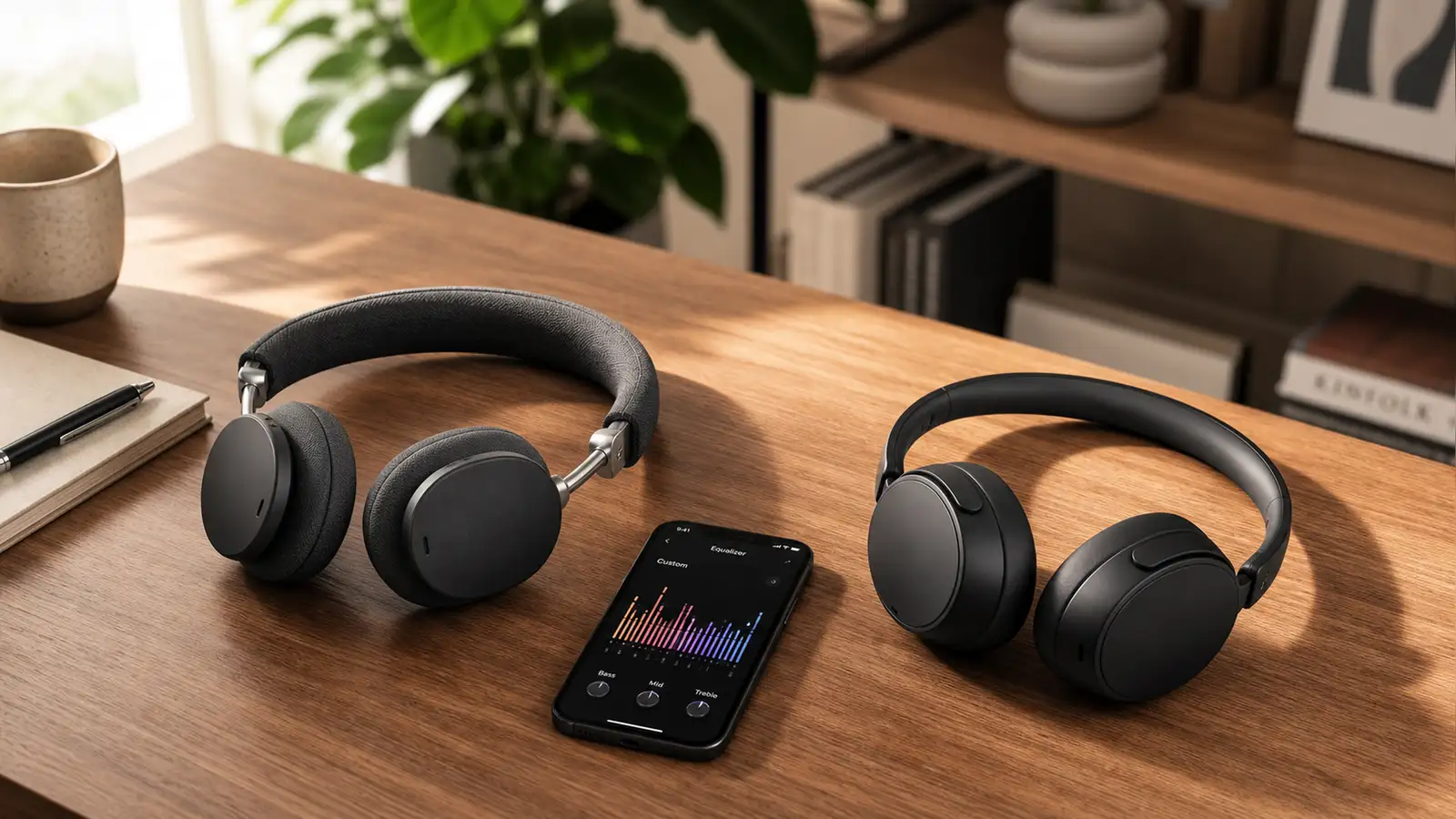
The over-ear wireless headphone market has two clear philosophies battling for your ears — and your wallet. On one side, Sony’s WH-1000XM series has dominated the mainstream for half a decade, winning on noise cancellation, smart features, and broad appeal. On the other, Sennheiser’s Momentum line has carved out a loyal following among listeners who refuse to compromise on sound quality, even when cutting the cord. The Momentum 4, released in 2022 and refined through firmware updates into 2026, represents Sennheiser’s most ambitious attempt to match Sony on features while keeping its audiophile DNA intact. The WH-1000XM6, Sony’s 2025 flagship refresh, brings redesigned drivers, an upgraded V2 processor, and refinements that address nearly every complaint users had about the XM5. I spent over three months daily-driving both pairs through commutes, work sessions, long-haul flights, and late-night listening marathons. Here’s how they stack up.
Design and Build Quality
Sennheiser took a radical departure with the Momentum 4’s design. Gone is the retro, exposed-metal aesthetic of the Momentum 3 — replaced by a minimalist, fabric-wrapped headband and matte-finished ear cups that look more Scandinavian than Bavarian. The headphones fold flat but don’t collapse inward, so the included case is notably larger than Sony’s. Build quality feels premium throughout: the headband slider is reinforced steel, the ear cup yokes are solid aluminum, and the synthetic leather ear pads are thick, plush, and replaceable. At 293 grams, they’re slightly heavier than the XM6 but distribute weight well enough that fatigue rarely sets in before the four-hour mark.
Sony stuck closer to the XM5’s DNA with the XM6. The design language remains sleek and understated — matte plastic that resists fingerprints, a slimmer headband with improved padding, and ear cups that now rotate flat for easier storage. The XM6 weighs 249 grams, making it one of the lightest flagship ANC headphones available, and that weight difference is genuinely noticeable during marathon listening sessions. Sony’s ear pads use a new memory foam formulation that conforms faster to the shape of your ears. The XM6 still doesn’t fold into a compact ball like the XM4 did, which remains a divisive choice among travelers who miss the ultra-portable form factor of previous generations.
The physical control philosophy differs sharply between the two. Sennheiser uses a combination of tactile buttons — play/pause, volume rocker, and a multi-function button — all on the right ear cup. There’s no touch surface anywhere on the Momentum 4, which some users will find refreshingly unambiguous and others will find dated. Sony continues with its touch panel on the right ear cup for playback and volume, supplemented by a physical power/Bluetooth button and the new “Quick Attention” capacitive sensor on the left. Neither approach is objectively better, but Sony’s touch gestures become second nature within days, while Sennheiser’s buttons are more reliable with gloves or wet hands.
Sound Quality
This is where the philosophical divide becomes most apparent — and where both headphones genuinely excel in different ways.
The Momentum 4’s 42mm drivers are tuned by Sennheiser’s audiophile engineering team, and it shows. The default frequency response is warmer and more natural than the XM6, with a midrange presence that makes vocals, acoustic instruments, and orchestral recordings sound remarkably lifelike. Bass extends deep without bleeding into the lower mids — there’s sub-bass rumble when the track calls for it, but the Momentum 4 never inflates low-end for the sake of excitement. Treble is detailed and airy without crossing into sibilance. The soundstage is the real differentiator: the Momentum 4 presents music with width and depth that the XM6 can’t quite match, giving each instrument room to breathe.
Sony’s XM6 uses newly designed 30mm drivers with a carbon-fiber composite diaphragm, and the tuning has shifted noticeably from the XM5. The XM6 is more neutral out of the box than any previous Sony flagship, dialing back the mid-bass hump that characterized earlier generations. That said, it’s still a more exciting listen than the Momentum 4 — bass hits harder when called for, and the upper treble sparkle adds energy to pop, hip-hop, and electronic music. The XM6 doesn’t sound artificial or over-processed; it sounds like a very good consumer headphone that’s been tuned to make everything sound engaging rather than strictly accurate.
Both support high-resolution Bluetooth codecs. The Momentum 4 supports SBC, AAC, aptX, and aptX Adaptive (up to 24-bit/96kHz on compatible devices). The XM6 supports SBC, AAC, and Sony’s proprietary LDAC at up to 24-bit/96kHz. In practice, the codec advantage tips toward whichever ecosystem you’re in: Android users get high-bitrate streaming on both, while iPhone users are stuck with AAC regardless. The Momentum 4’s wired USB-C audio mode is a standout feature — plug directly into a laptop or phone and the internal DAC/amp processes audio at up to 24-bit/96kHz, bypassing Bluetooth compression entirely. The XM6 also supports wired USB-C audio but routes through a simpler signal path that doesn’t quite match the Momentum 4’s wired fidelity.
After three months of alternating between them, I kept gravitating toward the Momentum 4 for focused listening sessions — jazz, classical, acoustic, and vocal-heavy tracks simply sound richer and more nuanced. The XM6 became my default for everything else: podcasts, YouTube, gym playlists, and background music while working. If sound quality is your absolute priority and you’re willing to trade some convenience features, the Momentum 4 is the clear winner. If you want excellent — not just good — sound that works across every genre without ever sounding boring, the XM6 is the safer bet.
Active Noise Cancellation
For years, Sony has worn the ANC crown, and the XM6 extends that lead. The integrated V2 processor combined with eight microphones (up from the XM5’s four) creates a noise-cancelling experience that borders on eerie. Low-frequency rumble — airplane engines, train noise, HVAC systems — is essentially erased. Mid-frequency attenuation has improved dramatically: office chatter, coffee shop ambience, and keyboard clatter are reduced to barely perceptible whispers. Even high-frequency noise like the whine of a laptop fan gets partially tamed. The transparency mode is equally impressive, sounding natural and unprocessed, with none of the digital harshness that plagued early ambient sound modes.
The Momentum 4’s ANC is good — genuinely good — but it operates a tier below Sony’s best. Low-frequency cancellation is competitive, but mid and high-frequency isolation doesn’t match the XM6. In a busy office, you’ll still hear keyboard noise through the Momentum 4 at low volumes, where the XM6 renders it nearly inaudible. The transparency mode on the Momentum 4 is perfectly usable but has a slightly compressed quality compared to Sony’s wide-open, natural pass-through. Sennheiser has improved ANC through firmware updates since launch, closing some of the gap, but the hardware limitations of the four-microphone array prevent it from truly catching up to Sony’s eight-microphone setup.
For frequent flyers, commuters, or anyone working in noisy environments, the XM6’s ANC advantage alone justifies the price difference. The Momentum 4 is adequate for most situations, but “adequate” isn’t what you want from a $350+ headphone when the competition delivers class-leading silence.
Features and Battery Life
Sony packs the XM6 with features that range from genuinely useful to occasionally gimmicky. Speak-to-Chat automatically pauses music and pipes in ambient sound when you start talking — great for quick conversations at coffee shop counters, less great when you absentmindedly hum along to a song. Quick Attention, activated by placing your palm over the right ear cup, is faster than any transparency toggle. Multipoint Bluetooth connects to two devices simultaneously and switches intelligently between them. DSEE Extreme upscaling improves compressed audio streams, though the effect is subtle on high-bitrate sources. Head tracking for spatial audio works with select streaming services and adds an immersive dimension to movies and supported music.
The Momentum 4’s feature set is more restrained. Multipoint Bluetooth works reliably. Sidetone lets you hear your own voice during calls. The Smart Control app offers a comprehensive five-band equalizer with a sound personalization wizard that genuinely improves the listening experience — it’s more flexible than Sony’s EQ options, which are limited to a five-band graphic EQ and a “Find Your Equalizer” guided setup. Wind noise reduction during calls is excellent on both, though the XM6’s additional microphones give it a slight edge in extremely noisy conditions.
Battery life is where Sennheiser lands a knockout punch. The Momentum 4 delivers a frankly absurd 60 hours with ANC enabled. That’s not a typo — sixty hours. At three hours of daily listening, you can go nearly three weeks between charges. The XM6 manages a still-respectable 40 hours with ANC on and 50 hours without, which is double what most users need between charges but notably less than the Sennheiser. Both support quick charging: 10 minutes on the Momentum 4 nets roughly 6 hours of playback, while the XM6 gets about 5 hours from the same quick charge.
Call quality is a toss-up. The XM6’s eight-microphone array with bone-conduction sensors produces cleaner voice pickup in noisy environments, but the Momentum 4’s sidetone implementation makes calls feel more natural to the wearer. For podcast recording or professional calls, the XM6 is the better tool. For casual phone calls, either works well.
Comfort and Daily Use
The XM6’s 44-gram weight advantage is the headline spec, but comfort is about more than grams. Sony’s new ear pad foam is genuinely more comfortable during multi-hour sessions — it conforms faster and generates less heat. The reduced clamping force compared to the XM5 is a welcome change for users with larger heads or those who wear glasses. I could wear the XM6 for an entire eight-hour workday without discomfort, something I couldn’t say about its predecessor.
The Momentum 4 is comfortable in a different way. The ear cups are larger and deeper, fully enclosing even larger ears without pinching. The headband padding is more generous, and the clamping force strikes a balance between secure fit and long-term comfort. Where the Momentum 4 falls slightly short is heat buildup — the synthetic leather pads don’t breathe as well as the XM6’s newer material, leading to warmer ears during extended summer listening. For most users, both headphones will be comfortable enough for several hours of continuous use, but the XM6 edges ahead for all-day wear.
Price and Value
As of mid-2026, the pricing landscape has shifted. The Momentum 4, now over three years old, regularly dips to $280–$300 on sale, with a list price hovering around $350. The XM6, being newer, holds firmer at $400, with occasional discounts to $370. That’s a meaningful $70–$120 gap that favors the Sennheiser for value-conscious buyers.
For the money, the Momentum 4 gives you superior sound quality, unmatched battery life, wired USB-C audio support, and ANC that’s good enough for all but the noisiest environments. The XM6 asks for a premium and justifies it with class-leading ANC, lighter weight, smarter features, and a more versatile sonic signature that pleases a broader audience.
Final Verdict
Choosing between these two headphones comes down to a single question: what matters more — absolute sound quality or everything else?
If you answered sound quality, buy the Sennheiser Momentum 4. Its richer, more natural tuning, wider soundstage, and wired USB-C audio mode make it the superior choice for listeners who treat music as an activity rather than background noise. The 60-hour battery life and lower street price are compelling bonuses that make the Momentum 4 one of the best value propositions in premium audio.
If you answered everything else — or if you frequently find yourself in noisy environments — buy the Sony WH-1000XM6. The ANC is untouchable, the lighter design is more comfortable for all-day wear, the feature set is richer, and the sound quality, while not quite matching the Momentum 4’s audiophile credentials, is excellent in its own right. The XM6 is the more complete package, and for most people, it’s the better headphone.
For this comparison, I’m giving the overall win to the Sony WH-1000XM6. The ANC gap is simply too large to ignore for a pair of wireless noise-cancelling headphones, and the XM6’s combination of excellent sound, benchmark-setting silence, and all-day comfort makes it the headphone I’d recommend to nine out of ten people. The Momentum 4 remains a fantastic choice for the tenth person — the one who cares most about how music sounds and is willing to accept very good ANC instead of the absolute best.